How to Calculate Cap Rate on a Rental Property (2026 Guide for Small Landlords)
How to Calculate Cap Rate on a Rental Property (2026 Guide for Small Landlords) A cap rate is a rental property's net operating income divided by its

How to Calculate Cap Rate on a Rental Property (2026 Guide for Small Landlords)
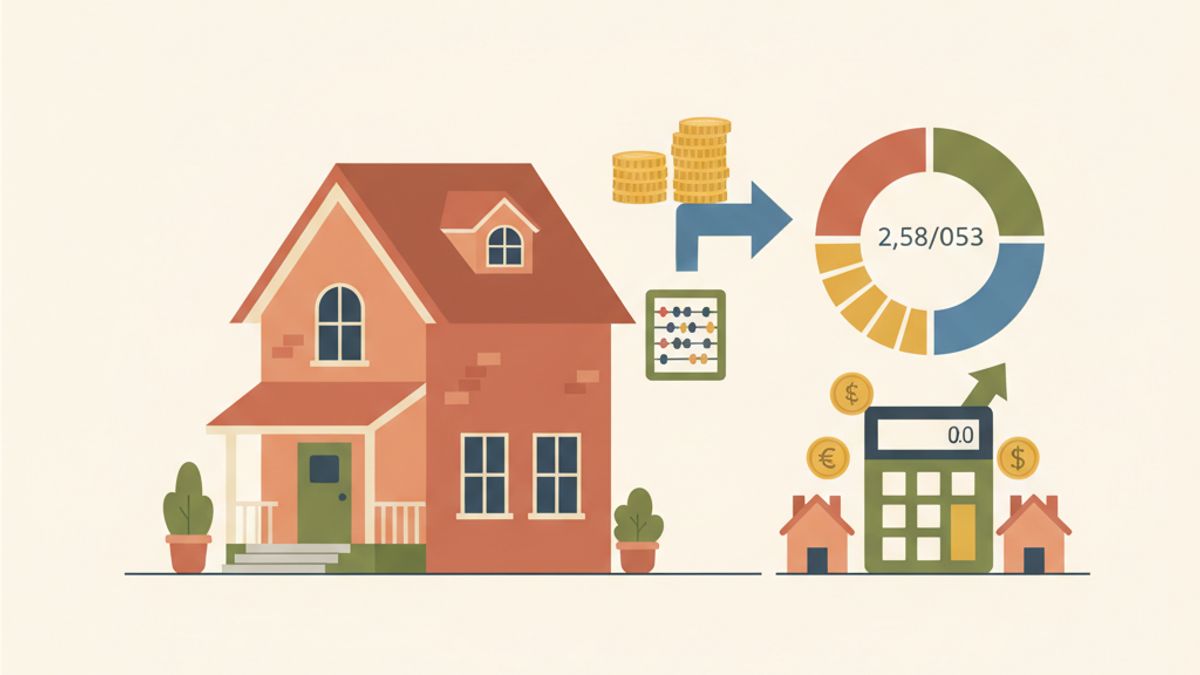
A cap rate is a rental property's net operating income divided by its purchase price, shown as a percentage. It estimates the annual return a property would earn if you bought it with cash. In 2026, most small landlords should aim for roughly 5–8%, depending on their local market and risk.
| At a Glance | The Short Answer | Why It Matters |
|---|---|---|
| What is cap rate? | Net operating income ÷ purchase price × 100 | Measures a building's raw return, with no mortgage involved |
| What is good in 2026? | 5–8% in most secondary markets; 3–5% in big coastal metros | A lower cap rate is not always bad — it often means a pricier, safer market |
| The #1 rule of the formula | Never put your mortgage payment in the expenses | Debt service belongs in cash-on-cash return, not cap rate |
| Fastest way to run the numbers | Use a free cap rate calculator | Stops the small math slips that make bad deals look good |
You found a duplex. The seller says it pencils out. Your gut says one thing and the listing sheet says another. We have been there. Cap rate is the one number that settles most of those arguments, and below we show you exactly how to calculate it on a real duplex, what a good cap rate looks like in 2026, and the five mistakes that trick landlords into buying bad deals.
What Is a Cap Rate, and Why Should Small Landlords Care?
A cap rate (capitalization rate) measures how much money a property earns each year compared to what it costs to buy — before any loan. Think of it as the building's return if you paid all cash.
It matters for three reasons:
- It compares deals apples to apples. A $200,000 fourplex and a $450,000 duplex both boil down to one percentage.
- It shows how the market prices risk. A higher cap rate means more income for the price, but usually more risk or slower growth.
- It protects you from overpaying. If similar buildings near you sell at a 6% cap rate, a listing that only supports 4% is overpriced or has problems.
The Cap Rate Formula (Memorize This One Line)
Cap Rate = Net Operating Income (NOI) ÷ Purchase Price × 100
And NOI is:
NOI = All rental income − Vacancy − All operating expenses
Operating expenses include taxes, insurance, repairs, reserves, management fees, and any utilities you pay. They do not include the mortgage, income taxes, or big one-time renovations.
What Cap Rate Does NOT Tell You
- It ignores your loan. Two identical buildings can cash flow very differently depending on financing (see our cash flow guide).
- It ignores appreciation. Cheap 8% cap markets often grow slowly; 4% cap coastal cities often grow fast.
- It ignores your labor. Self-managing adds income the formula never sees.
How Do You Calculate Cap Rate on a Real Duplex? (A Worked Example)
Here is the example we will use for the whole article: a 1970s duplex in a Midwest college town, listed at $300,000, with both units renting at $1,400 per month.
Step 1: Start With Gross Scheduled Rent
$1,400 × 2 units × 12 months = $33,600 per year
That assumes every unit stays full and every tenant pays on time. That never happens, so:
Step 2: Subtract Vacancy and Add Other Income
- Vacancy at 5%: −$1,680
- Laundry income: +$600
- Effective gross income: $32,520
Step 3: List Every Real Operating Expense
| Operating Expense | Annual Cost |
|---|---|
| Property taxes | $3,600 |
| Insurance | $1,800 |
| Repairs and maintenance | $2,400 |
| CapEx reserve (roof, HVAC, water heaters) | $2,000 |
| Property management (8%) | $2,600 |
| Water, sewer, trash | $1,200 |
| Total | $13,600 |
Notice no mortgage payment appears in this list. That is on purpose. Track every recurring cost you can so nothing hides from the math.
Step 4: Divide NOI by the Purchase Price
- NOI = $32,520 − $13,600 = $18,920
- Cap rate = $18,920 ÷ $300,000 = 6.3%
Step 5: Sanity-Check the Answer
At 6.3%, the property's income pays back its purchase price in about 16 years, before appreciation and loan paydown. Run the same math on three nearby sales. If your number is far above or below theirs, something is wrong — either your expenses or the seller's price.
What Is a Good Cap Rate in 2026?
There is no universal good number. Cap rates move with interest rates, and in 2026 they vary hugely by market:
| Market Type | Typical 2026 Cap Rate | The Trade-Off |
|---|---|---|
| Top-tier coastal metros (NYC, LA, SF) | 3–4.5% | Safety and appreciation, thin income |
| Large mid-size and Sun Belt cities (Austin, Charlotte, Denver) | 4.5–6% | Balanced growth and yield |
| Secondary cities and small Midwest/South towns | 6–8% | Strong cash flow, slower appreciation |
| Distressed or value-add properties | 8%+ | High reward, high risk, heavy work |
Compare the Cap Rate to Your Borrowing Cost
This is the move most beginners skip in 2026: subtract your mortgage rate from the cap rate.
- Cap rate 6.3% with a 7% loan = negative leverage — every borrowed dollar drags your return down.
- Cap rate 6.3% with a 6% loan = positive leverage — the loan amplifies your return.
If rates sit above local cap rates, buy with a bigger down payment, wait, or shop markets where cap rates run higher.
Three Actions to Take Before You Offer
- Pull sold comps nearby and estimate the neighborhood cap rate.
- Get a real rate quote from your lender before you fall in love with a deal.
- Only offer where cap rate minus mortgage rate is near zero or better.
Cap Rate vs. the 1% Rule vs. Cash-on-Cash Return: Which One Do You Use When?
These three get mixed up constantly. They answer different questions:
| Metric | Formula | Question It Answers | Best Use |
|---|---|---|---|
| Cap rate | NOI ÷ purchase price | What does the building itself earn? | Comparing deals and markets quickly |
| 1% rule | Monthly rent ÷ purchase price | Is rent high relative to price? | A 30-second filter while browsing listings (see our 1% rule breakdown) |
| Cash-on-cash return | Annual cash flow ÷ cash you invested | What does my money earn, with the loan? | Judging a deal with real financing in place |
Our Simple Screening Order
- 1% rule filter — kill the obvious duds in seconds.
- Cap rate check — price the survivors against the local market.
- Cash-on-cash return — run real loan terms on the finalists.
Only step 3 tells you what your bank account will actually feel. Steps 1 and 2 get you there without wasting your weekends.
How Do You Use a Free Cap Rate Calculator (Without Spreadsheet Errors)?
You can do all of this by hand, but one mistyped formula quietly wrecks an offer. So we built a free cap rate calculator into Property Aura, and it is embedded below for you to use right now:
🧮 Free Cap Rate Calculator Enter: purchase price, closing costs, monthly rent per unit, vacancy %, and each expense line (taxes, insurance, maintenance, CapEx, management, utilities). Get back: NOI, cap rate, cash-on-cash return, a 1% rule score, and break-even vacancy — all in one pass.
What to Enter (and What to Leave Out)
- Include: taxes, insurance, repairs, CapEx reserve, management fee, utilities you pay, and honest vacancy.
- Leave out: the mortgage payment, income taxes, and one-time renovation budgets (add those to your total cost instead).
What the Output Should Tell You
- A cap rate at or above your local market norm.
- Positive or near-zero leverage versus your quoted loan rate.
- A cash-on-cash return you would actually accept — many landlords want 8% or better.
Why We Put the Calculator Inside the Tool You Manage With
| Feature | Property Aura | Stessa | TurboTenant |
|---|---|---|---|
| Free cap rate / deal calculator | Yes — built into every property | Portfolio performance focus, less deal screening | Not a core feature |
| NOI updates from real income and expenses | Yes, automatically | Yes | Partial |
| Rent collection and tenant portal | Yes | Limited | Yes |
| Maintenance tracking tied to expenses | Yes | Basic | Yes |
| Landlord accounting and tax-ready reports | Yes | Yes | Paid tiers |
| Best for | Small landlords who analyze AND operate | Tracking rentals you already own | Screening and rent payments |
Spreadsheets cannot pull in what you actually spent last quarter. Property Aura can — and that is exactly what NOI is supposed to reflect.
What Common Mistakes Make Bad Rental Deals Look Good?
Mistake 1: Subtracting the Mortgage Payment in the Cap Rate Math
The Mistake: Plugging your loan payment into operating expenses and calling the result a cap rate. That is a financed return, not a cap rate. The Cost: You can no longer compare properties to each other or to the market, and financing-dependent math hides overpaying.
Mistake 2: Skipping Vacancy, Maintenance, and CapEx Reserves
The Mistake: Using the seller's numbers with 0% vacancy and zero reserves. The Cost: The cap rate reads 8% when the real number is 5%. That gap can wipe out years of cash flow the first time the roof fails.
Mistake 3: Trusting the Pro Forma Instead of Actual Numbers
The Mistake: Using projected market rents instead of the in-place leases. The Cost: If real rents are $100 per unit lower than the pro forma, that is $2,400 a year on our duplex — roughly $38,000 of value at a 6.3% cap rate. Always ask for the rent roll and actual expense history.
Mistake 4: Comparing Cap Rates Across Markets or Property Types
The Mistake: Rejecting a solid 4.5% deal in a growing city because you read that 8% exists somewhere else — or comparing a long-term duplex to a short-term rental. The Cost: You either freeze and buy nothing, or you chase high-cap deals in shrinking towns where vacancy eats the extra yield.
Mistake 5: Using List Price Instead of True Total Cost
The Mistake: Dividing NOI by the sticker price while ignoring closing costs (2–5%) and day-one repairs. The Cost: Our $300,000 duplex is really about $318,000 with closing costs. The cap rate silently drops from 6.3% to 5.9%. Good calculators let you add those costs in.
Cap Rate FAQs
1. Do I include my mortgage payment when I calculate cap rate?
No. Cap rate measures the building, not your loan. Mortgage payments belong in cash-on-cash return and cash flow math.
2. Is a higher cap rate always better?
No. Higher cap rates usually mean more risk — weaker tenant demand, slower growth, or bigger repair bills. Match the number to your risk tolerance.
3. What cap rate should I look for on a small duplex in 2026?
In most Midwest and Southern markets, 6% or better is a fair target. In large coastal metros, 4–5% can still be a fine deal if rents and values are stable.
4. Does cap rate change after I buy the property?
Yes. Cap rate is NOI divided by value, so every rent raise, expense change, and market swing moves it. Re-check it yearly — Property Aura updates NOI automatically from your real books.
5. How is cap rate different from ROI?
ROI is broader — it can include appreciation, loan paydown, and your time. Cap rate is deliberately narrow: one year of building income against one purchase price. Use cap rate to shop, and ROI to judge the full picture.
Run the Numbers Before You Fall in Love
Cap rate will not tell you everything, but it will stop you from buying a pretty building that loses money. Run every deal through our free cap rate calculator, then let Property Aura keep tracking real income and expenses after closing — rent collection, maintenance, and tax-ready accounting in one simple dashboard. Try Property Aura free and make your next offer with numbers, not nerves.
Related Topics
Related Articles

How to Legally Evict a Tenant: A Step-by-Step Guide for Small Landlords To evict a tenant legally, serve a written notice (pay-or-quit or cure-or-quit

How to Reduce Vacancy Rates on Your Rental Property: A Pre-Leasing Playbook for Small Landlords Every vacant week costs you about a quarter of your mo
The 1% Rule for Rental Properties: Does It Still Work in 2026? The 1% rule is a quick screen for rental deals: monthly rent should be at least 1% of t