How to Set the Right Rent Price for Your Rental Property (2026 Guide for Small Landlords)
How to Set the Right Rent Price for Your Rental Property (2026 Guide for Small Landlords) To set the right rent price, compare at least five similar r

How to Set the Right Rent Price for Your Rental Property (2026 Guide for Small Landlords)
To set the right rent price, compare at least five similar rentals within one mile, adjust for your unit's size and condition, then divide your total monthly costs by your target rent-to-cost ratio. Recheck prices every 6 to 12 months so you never leave money on the table.
| What You'll Learn | Time Needed | Who This Helps |
|---|---|---|
| How to research local rents and pick your number | 30 minutes | Landlords with 1–50 units |
| How to avoid overpricing and long vacancies | Ongoing habit | New and small landlords |
| Tools that make pricing and rent collection easy | 10 minutes to set up | Anyone tired of spreadsheets |
Why Does Pricing Your Rent Correctly Matter So Much?
We've seen it happen over and over: a landlord prices a unit $150 too high, and it sits empty for six weeks. That's over $2,000 lost — more than a full year of "extra" rent from the higher price.
On the flip side, pricing too low costs you money every single month, and you can't get it back.
Action Steps
- Write down your current asking rent and your actual monthly costs (mortgage, taxes, insurance, maintenance reserve).
- Calculate what one vacant month costs you (monthly rent minus any costs that stop during vacancy).
- Use that number as your "pricing risk budget" — if overpricing risks even two weeks vacant, it's rarely worth it.
How Do You Research What Similar Rentals Are Charging?
Start with real listings, not gut feelings.
Action Steps
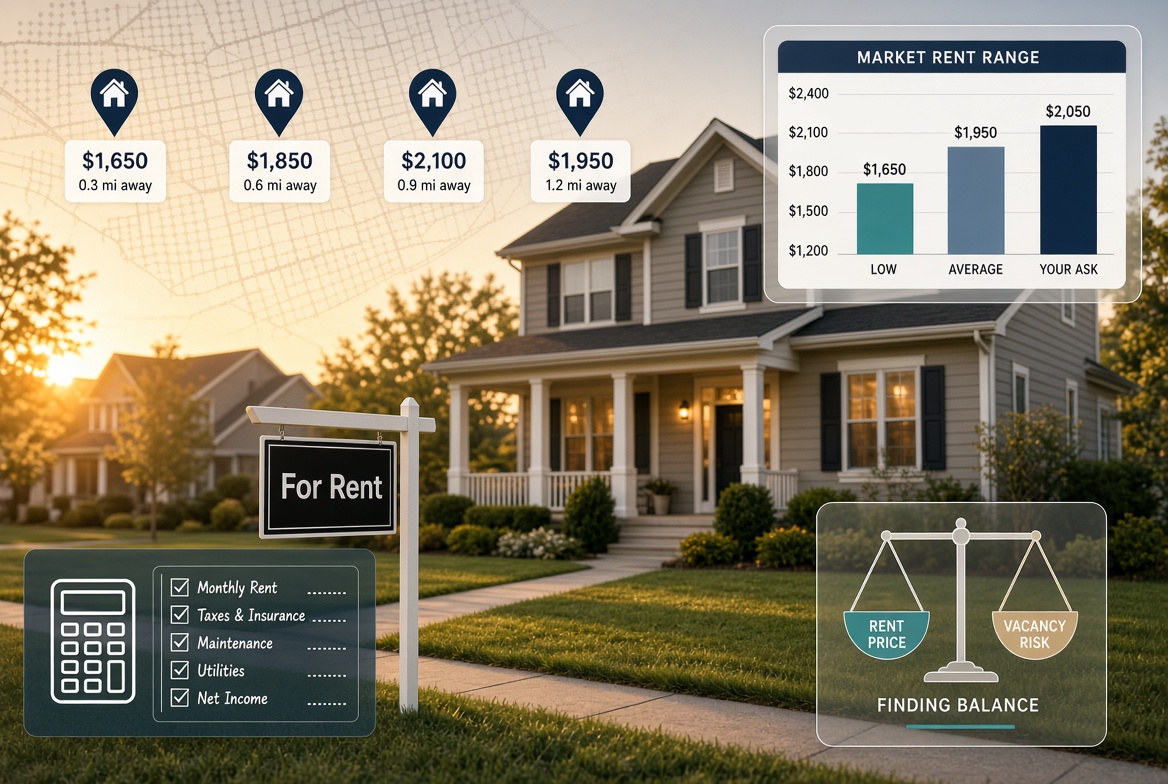
- Search Zillow, Apartments.com, and Facebook Marketplace for units like yours within one mile.
- Only compare units with similar bedrooms, bathrooms, and condition. A renovated 2-bed and a dated 2-bed are not the same product.
- Build a simple comparison table: address, rent, beds, baths, condition, days listed.
- Ignore listings that have been up 60+ days — they're likely overpriced.
- Land on a range (say $1,650–$1,750), not a single number.
How Should You Adjust Rent for Your Unit's Features?
The comps give you the baseline. Your unit's specifics move you up or down within that range.
Action Steps
- Add value for in-unit laundry, updated kitchens, parking, or included utilities (roughly $25–$75 each, depending on your market).
- Subtract for dated finishes, street noise, no parking, or tenant-paid utilities where comps include them.
- Price slightly below the top of your range if you want faster placement — vacancy is expensive.
- Check pet policies in your comps; pet-friendly units often justify a premium or pet rent.
How Does Your Cost Structure Affect What You Should Charge?
Rent isn't just about the market — it has to cover your numbers too.
Action Steps
- List every monthly cost: mortgage, taxes, insurance, HOA, utilities you pay, and a 5–10% maintenance reserve.
- Divide total costs by rent. If your rent-to-cost ratio is below 1.2, you may be barely breaking even — review our guide on rental cash flow.
- If your market rent can't cover your costs, don't panic-raise rent past the market. Fix the cost side or reassess the investment.
- Remember: you can only raise rent at renewal in most states, and many have rent increase notice laws (often 30–60 days). Plan ahead.
When and How Should You Raise Rent on Existing Tenants?
Keeping a good tenant is almost always cheaper than turnover, which can cost $2,000–$4,000 per unit.
Action Steps
- Check your market comps 90 days before each lease renewal.
- Raise in small, predictable steps (3–5% is common) rather than one big jump.
- Send written notice early, and follow your state's required notice period.
- Include a renewal letter explaining the increase — tenants accept fair, explained increases far better.
- If a great tenant is slightly below market, weigh the small discount against the cost of turnover. Sometimes it's worth it.
How Do Small Landlords Track Rent Once the Price Is Set?
Pricing is half the job. Collecting that rent on time, every month, is the other half — and it's where spreadsheets fall apart.
Comparison: Property Aura vs Competitors
| Feature | Property Aura | TenantCloud | Avail |
|---|---|---|---|
| Starting price | Simple, affordable plans | Free tier, paid from ~$15/unit | Free tier, paid from ~$7/unit |
| Online rent collection (ACH) | Included, with automatic reminders | Included | Included |
| Late fee automation | Yes, automatic | Yes | Yes |
| Maintenance tracking | Built in | Built in | Built in |
| Accounting/expense tracking | Built in, Schedule E-friendly | Basic | Basic |
| Ease of setup for 1–50 units | Very easy | Moderate | Easy |
We built Property Aura because we were tired of small landlords paying enterprise prices for features they'd never use.
Common Mistakes When Setting Rent
- The Mistake: Copying the highest listing you see. The Cost: Weeks of vacancy that wipe out any pricing gain.
- The Mistake: Never raising rent for years to "be nice." The Cost: You fall $200+/unit below market and face one painful catch-up later.
- The Mistake: Ignoring seasonality (pricing a unit in November like it's May). The Cost: Longer vacancies; most markets peak in spring and summer.
- The Mistake: Not knowing your actual costs. The Cost: You might be renting at a loss and not even know it.
- The Mistake: Skipping written notice for increases. The Cost: Legal exposure and an unenforceable rent change.
FAQs
1. How often should I review my rent price? At least once a year, ideally 90 days before each lease renewal. Markets shift fast, especially in growing areas.
2. Is it better to price high and negotiate down? Usually no. Overpriced listings go stale, and stale listings attract lowball offers. Price in the realistic range and screen for quality tenants instead.
3. How much can I legally raise rent? Most states have no cap, but you must give proper notice (often 30–60 days). Some cities with rent control limit increases to a set percentage. Check your local rules.
4. Should I charge rent based on square footage? Use it as a tiebreaker, not a rule. Bedrooms, location, and condition matter more to renters than a 50-square-foot difference.
5. What tools help with rent pricing and collection? Zillow Rent Zestimate and Rentometer for pricing research, and Property Aura for rent collection, reminders, late fees, and tracking income in one place.
Ready to Price Smarter and Collect Faster?
Once you've set the right rent, Property Aura makes the rest simple: online rent collection, automatic reminders, late fee tracking, and clean accounting for tax season. Built for landlords with 1–50 units — start free and see the difference in your first rent cycle.
Related Topics
Related Articles

Free lease renewal letter template for landlords with state-by-state notice deadlines, rent increase rules, and the exact clauses your renewal must include. Avoid the mistakes that cost landlords $2,400 in vacancy losses.
Complete guide to every Schedule E expense category for rental property owners. Line-by-line breakdown of deductible expenses, what goes where, and how small landlords recover $3,000-$8,000 in missed deductions each year.

Expert guide for accidental landlords in 2026 on 7 first-year mistakes that cost $8,000-$15,000, with specific dollar amounts and step-by-step fixes.