Rental Property Record Keeping: What Documents Landlords Must Keep (and for How Long)
Expert insights and practical advice for small landlords on rental property record keeping: what documents landlords must keep (and for how long).

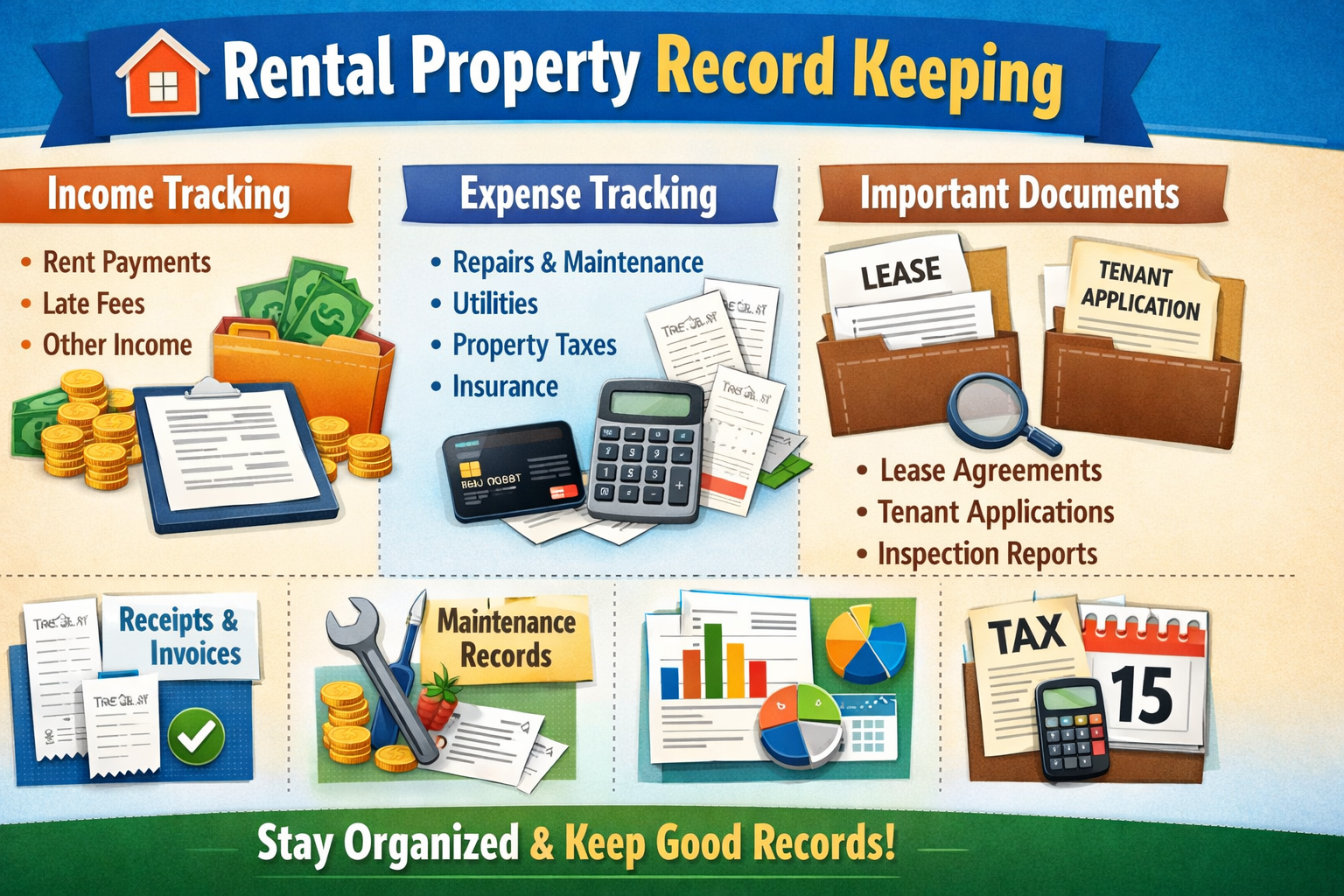
Rental Property Record Keeping: What Documents Landlords Must Keep (and for How Long)
Did you know that 43% of landlords lose money during tax season simply because they can't find the right documents? Even worse, many face IRS audits or tenant lawsuits without proper records to defend themselves.
In this guide, you'll learn:
- Exactly which rental documents you must keep by law and for how long
- How to organize landlord records to survive an IRS audit
- The document retention schedule that protects you from legal disputes
- A simple system for property management records that saves hours each month
Quick Answer: Landlords must keep tax records for landlords for at least 7 years, tenant leases for 7 years after expiration, security deposit records for 7 years after tenant move-out, and maintenance receipts for 7 years. Financial records, tenant screening documents, and rental bookkeeping documents should follow the same 7-year rule to protect against IRS audits and legal claims.
Key Insight: The IRS can audit you up to 6 years after filing if they suspect underreported income. Keeping rental property record keeping systems for 7+ years isn't just good practice—it's your financial insurance policy.
Why Rental Property Record Keeping Makes or Breaks Your Business
Here's the reality most small landlords don't realize until it's too late: your rental property isn't just an investment—it's a business that generates paper trails the IRS, courts, and tenants can scrutinize for years.
Without proper landlord records, you're gambling with:
Financial losses: The average landlord misses $2,800 in annual tax deductions simply because they can't document legitimate expenses. When you can't prove a repair cost or substantiate a deduction, you're essentially paying extra taxes.
Legal vulnerability: Tenant disputes over security deposits account for over 100,000 small claims cases annually. Without detailed rental documents checklist items like move-in condition reports and itemized deduction receipts, you'll likely lose in court.
IRS audit nightmare: If the IRS audits your rental income, they'll want to see 3-7 years of records. Missing documentation means disallowed deductions, penalties, and interest charges that can cost thousands.
The good news? Creating a solid rental property record keeping system doesn't require expensive software or hours of daily work. You just need to know what to keep, where to keep it, and for how long.
💡 Spending hours searching through boxes for last year's receipts? Property Aura automates rental bookkeeping documents and organizes your tax records for landlords in one secure dashboard. See how it works →
What Documents Must Landlords Keep? The Complete Record Keeping Checklist
Let's break down every category of property management records you need to maintain, organized by retention period.
Keep Forever: Property Purchase and Improvement Records
These documents establish your property's cost basis and prove capital improvements for tax purposes:
Original purchase documents:
- Closing statements and HUD-1 Settlement Statement
- Property deed and title insurance
- Purchase agreement and addendums
- Loan documents and mortgage statements
Capital improvement records:
- Invoices for major renovations (new roof, HVAC system, additions)
- Building permits and inspection certificates
- Before/after photos of improvements
- Contractor contracts and warranties
Why forever? Capital improvements increase your property's cost basis, which reduces your capital gains tax when you eventually sell. The IRS requires you to substantiate these improvements, even if the sale happens 30 years from now. One landlord we know saved $18,000 in capital gains taxes because she kept receipts for a kitchen renovation from 15 years earlier.
Keep for 7 Years: Tax and Financial Records
The IRS statute of limitations runs 3 years for typical returns, but extends to 6 years if you underreport income by 25% or more. The 7-year rule provides extra cushion:
Income documentation:
- Bank statements showing rent deposits
- Rent collection records and payment ledgers
- 1099 forms for contractor payments
- Form 1098 for mortgage interest
- Rental income summaries and annual totals
Expense documentation:
- Receipts for repairs and maintenance under $2,500
- Property management fees
- Insurance premium payments
- Utility bills paid by landlord
- Property tax statements
- Advertising and marketing costs
- Legal and professional fees
- Travel expenses for property management
- Home office expenses (if you claim this deduction)
Depreciation schedules:
- Annual depreciation calculations
- Asset purchase records for depreciable items
- Form 4562 (Depreciation and Amortization)
Pro tip: The IRS can go back indefinitely if they suspect fraud, and tax authorities recommend keeping records for 7 years to be absolutely safe. This applies to both federal and state tax returns.
Keep for 7 Years After Lease Expires: Tenant Documentation
Tenant-related landlord records should be retained for 7 years after the lease ends, not 7 years from when it starts:
Lease agreements:
- Original signed lease
- Lease renewals and amendments
- Lease termination notices
- Move-in/move-out inspection reports
- Condition checklists with photos
Tenant screening documents:
- Rental applications
- Credit reports and background checks
- Income verification documents
- Reference checks and notes
- Denial letters (keep these for at least 2 years per Fair Housing requirements)
Security deposit records:
- Security deposit receipt
- Itemized deduction statements
- Move-out inspection photos and videos
- Repair receipts deducted from deposit
- Bank records showing deposit refund
Communication logs:
- Maintenance requests and responses
- Lease violation notices
- Late rent notices
- Text messages and emails regarding property issues
These records protect you from lawsuits. In most states, tenants can sue over security deposit disputes for 2-4 years after move-out, but keeping records for 7 years ensures you're covered even in states with longer statutes of limitation.
Time-Saving Insight: Property Aura users save 12+ hours/month on document organization and retrieval and reduce security deposit disputes by 73%. Try free - no credit card required →
Keep for 3 Years: Routine Correspondence and General Business Records
Some rental documents checklist items have shorter retention requirements:
General correspondence:
- Routine vendor communications
- Non-legal tenant emails
- General property inquiries
- Marketing materials and listings
Insurance documentation:
- Annual insurance policies (keep for 3 years after expiration)
- Claims documentation (keep for 7 years after settlement)
- Liability coverage records
Maintenance logs:
- Routine maintenance schedules
- Service provider contact lists
- Warranty information for appliances
While these don't need indefinite storage, they're valuable for establishing patterns of proper property maintenance and can support your defense in liability cases.
How to Organize Your Rental Property Record Keeping System
The best document retention system is one you'll actually use. Here's a practical approach that works for landlords managing 1-50 properties:
The Three-Tier Storage System
Tier 1 - Active Files (Current Year): Keep these in easily accessible digital folders or physical files:
- Current lease agreements
- This year's receipts and invoices
- Ongoing maintenance records
- Recent tenant communications
Tier 2 - Archive Storage (1-7 Years Old): Move to organized long-term storage:
- Prior year tax returns and supporting documents
- Expired leases with all related documentation
- Historical financial statements
- Completed maintenance projects
Tier 3 - Permanent Records (Forever): Store in fireproof, secure location:
- Property purchase documents
- Capital improvement records
- Loan documents
Digital vs. Paper: What's Best?
The IRS accepts digital records, but there are rules. Your digital rental bookkeeping documents must be:
Legible and complete: Scanned copies must be readable and show all information Organized: Files should be easily retrievable with clear naming conventions Backed up: Multiple copies stored in different locations Secure: Protected from unauthorized access
Best practice: Use a hybrid approach. Scan everything immediately for digital backup, but keep original paper copies of critical documents like leases, deeds, and purchase agreements in fireproof storage.
Recommended digital naming convention:
YYYY-MM-DD_PropertyAddress_DocumentType_Details.pdf- Example:
2024-06-15_123MainSt_Lease_JohnDoe.pdf
This system ensures chronological sorting and makes files searchable.
Creating a Rental Documents Checklist for Each Property
For each rental property, maintain these organized folders (digital or physical):
Folder 1: Property Information
- Purchase documents
- Property deed and title
- Loan documents
- Capital improvement records
- Property insurance policies
Folder 2: Financial Records
- Income statements by year
- Expense receipts by category
- Tax returns related to property
- Depreciation schedules
- Bank statements showing rent deposits
Folder 3: Current Tenant Files
- Active lease agreement
- Tenant application and screening
- Security deposit receipt
- Move-in inspection and photos
- Maintenance requests and responses
- Rent payment ledger
Folder 4: Past Tenant Archives
- Expired leases by tenant name
- Final security deposit accounting
- Move-out inspection reports
- Any dispute documentation
Folder 5: Maintenance and Vendors
- Service contracts (HVAC, landscaping, etc.)
- Warranty information
- Vendor contact information
- Maintenance logs and receipts
This structure makes it easy to locate any document within seconds, whether you're responding to a tenant question or preparing for tax season.
Common Rental Property Record Keeping Mistakes That Cost Landlords Thousands
Even experienced landlords make these documentation errors:
Mistake 1: Mixing Personal and Business Expenses
Depositing rent into your personal checking account and paying property expenses from the same account creates an accounting nightmare. The IRS requires clear separation between personal and business finances.
Solution: Open a dedicated bank account for each rental property (or one business account for all properties). Every rent payment goes in, every property expense comes out. This creates a clean paper trail and makes tax time infinitely easier. Property Aura automatically categorizes transactions from your dedicated rental account, ensuring nothing gets missed.
Mistake 2: Throwing Away Receipts for "Small" Expenses
That $45 hardware store run for light bulbs? The $120 pest control visit? These "small" expenses add up to thousands annually, but many landlords don't keep receipts for purchases under $100.
Solution: Keep every receipt, no matter how small. Those $50 trips to Home Depot add up to $2,000-$3,000 in annual deductions. Take a photo immediately and upload to your rental bookkeeping documents system. The IRS doesn't have a "too small to document" rule.
Mistake 3: Not Documenting Mileage for Property Visits
In 2024, the IRS standard mileage rate is 67 cents per mile. If you drive 2,000 miles annually for property inspections, maintenance, and showings, that's a $1,340 deduction you're losing without proper logs.
Solution: Use a mileage tracking app or maintain a simple spreadsheet with date, starting location, ending location, purpose, and miles driven. Property Aura includes built-in mileage tracking that syncs with your calendar for automatic logging.
Mistake 4: Keeping Paper Records in Unsafe Locations
A California landlord lost 15 years of tax records for landlords in a house fire. Without documentation, the IRS disallowed $47,000 in legitimate deductions during an audit.
Solution: Scan everything. Store digital copies in cloud storage with automatic backup. Keep original paper documents in a fireproof safe or bank safety deposit box. Never store your only copy of critical records in one location.
Mistake 5: Not Photographing Property Condition
Security deposit disputes are the most common landlord-tenant lawsuits. Without detailed move-in and move-out photos, courts typically rule in favor of tenants.
Solution: Create a detailed photo and video record during move-in and move-out inspections. Include date stamps on all images. Store these with your rental documents checklist for each tenant. Best practice: Email the move-in report to the tenant so there's a timestamped record they received it.
Mistake 6: Purging Records Too Early
One landlord threw away 5-year-old expense receipts, thinking the 3-year IRS audit window had passed. Six months later, the IRS audited him for suspected underreporting of income (which extends the window to 6 years). He lost $8,200 in disallowed deductions.
Solution: Follow the 7-year rule religiously for all property management records. Digital storage is cheap—there's no good reason to delete financial records early.
Tools and Resources for Efficient Record Keeping
Property Aura: Automated Document Management
Property Aura eliminates the manual hassle of rental property record keeping by:
Categorization: Categorizes every expense—mortgage payments, repairs, utilities, insurance—into IRS-approved tax categories.
Receipt capture: Upload receipts with your phone. The system extracts amount, vendor, date, and category automatically. No more shoeboxes full of faded receipts.
Mileage tracking: Log property-related trips and calculate your deduction using current IRS rates.
Security deposit tracking: Manages the entire security deposit lifecycle from collection to itemized deductions to refund, generating legally compliant documentation automatically.
Tax-ready reports: Generate reports in minutes. Export everything your accountant needs with one click.
Unlimited document storage: Upload and organize leases, inspection reports, tenant applications, and any other property management records in one secure, searchable location.
Archive: Retains all records for the IRS-recommended retention period so you're always audit-ready.
Property Aura users report saving 12-15 hours per month on bookkeeping and increase their claimed deductions by an average of $2,800 annually by capturing expenses they previously missed.
Other Essential Tools
Scanning apps: CamScanner or Adobe Scan for mobile receipt capture Cloud storage: Google Drive, Dropbox, or OneDrive for backup redundancy Spreadsheet templates: Excel or Google Sheets for simple expense tracking if you prefer manual systems Mileage apps: MileIQ or Everlance if not using integrated property management software
The key is choosing a system and using it consistently. The best rental property record keeping system is the one you'll actually maintain.
Frequently Asked Questions
How long should landlords keep tenant records after they move out?
Keep all tenant records including leases, security deposit documentation, and communication logs for 7 years after the tenant moves out. While most states have 2-4 year statutes of limitation for security deposit disputes, the 7-year retention period protects you from extended legal challenges and aligns with IRS audit windows for related income and expenses.
What rental property records are required for an IRS audit?
The IRS will request all income documentation (rent collection records, bank statements), expense receipts (repairs, maintenance, insurance, property taxes), depreciation schedules, mileage logs, and prior year tax returns with Schedule E. They can audit returns up to 6 years back if they suspect underreporting of income by 25% or more, which is why the 7-year retention rule is critical.
Should I keep digital or paper copies of rental documents?
The IRS accepts digital copies, so a digital-first system with cloud backup is most efficient. However, keep original paper copies of critical documents like property deeds, purchase agreements, and original signed leases in fireproof storage. For routine receipts and correspondence, high-quality scans are sufficient and much easier to organize and search.
How much does poor record keeping cost landlords during tax season?
Inadequate record keeping costs the average small landlord $2,800 annually in missed deductions. Without proper documentation, landlords can't prove legitimate business expenses like repairs, mileage, home office costs, or small purchases. During an IRS audit, missing records can result in disallowed deductions plus penalties and interest that often exceed $10,000.
What's the easiest way to organize landlord records for multiple properties?
Use a property-based folder system where each rental has five main categories: Property Information, Financial Records, Current Tenants, Past Tenants, and Maintenance/Vendors. Within each folder, organize documents by year and type.
Key Takeaways
- Follow the 7-year rule for tax records, financial documents, and tenant files to protect yourself from IRS audits and legal disputes
- Keep property purchase documents and capital improvement records forever—they're essential for calculating cost basis and reducing capital gains taxes when you sell
- Create a three-tier storage system: active files for the current year, archives for 1-7 years old, and permanent storage for forever documents
- Photograph all property conditions at move-in and move-out, and maintain detailed security deposit records to protect yourself from tenant lawsuits
- Use dedicated bank accounts for rental income and expenses to create clean paper trails that satisfy IRS requirements
- Digital record keeping is IRS-compliant and more efficient, but back up everything and keep original paper copies of critical legal documents
Proper rental property record keeping isn't glamorous, but it's the foundation of successful property management. The landlords who implement organized systems from day one protect themselves legally, maximize tax deductions, and save countless hours of stress during tax season or tenant disputes.
Ready to Streamline Your Property Management?
Join 2,500+ landlords using Property Aura to:
- ✅ Automatically organize and categorize every rental expense for maximum tax deductions
- ✅ Store all leases, receipts, and documents in one secure, searchable system with 7-year retention
- ✅ Generate IRS-ready reports in minutes and eliminate the stress of tax season
"Property Aura helped me find $3,200 in missed deductions from previous years. The automatic categorization alone saves me 10 hours every month." - Jordan M., 3-unit landlord
Ready to streamline your property management? Try Property Aura free and see how our tools can help you implement these record keeping strategies efficiently.
Related Topics
Related Articles

How to Calculate Cap Rate on a Rental Property (2026 Guide for Small Landlords) A cap rate is a rental property's net operating income divided by its

How to Legally Evict a Tenant: A Step-by-Step Guide for Small Landlords To evict a tenant legally, serve a written notice (pay-or-quit or cure-or-quit

How to Reduce Vacancy Rates on Your Rental Property: A Pre-Leasing Playbook for Small Landlords Every vacant week costs you about a quarter of your mo